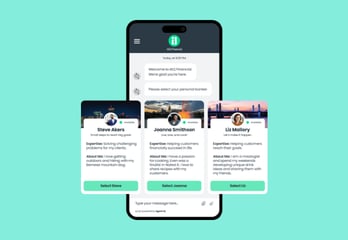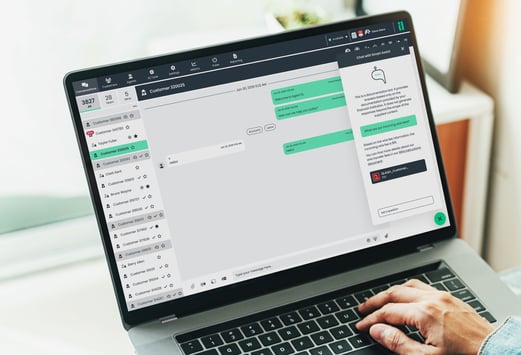
A banker copilot is an employee-facing AI assistant that helps financial institution staff find information, prepare for conversations, and complete routine work more efficiently. Unlike a chatbot designed primarily to serve account holders, a banker copilot works alongside employees. The best versions do not replace judgment or make decisions for people. They help employees get to the right information faster so they can spend more time helping account holders.
There is an important reason we like the word copilot.
A copilot does not fly the plane alone.
They help the person in control understand what is happening, access the right information, and make better decisions.
One quick distinction: when we say banker copilot, we are not referring to Microsoft Copilot. We are using copilot more broadly to describe an AI assistant that works alongside financial institution employees.
In banking, that kind of assistant has to do more than generate a useful response. It needs to work within the institution’s approved knowledge, roles, permissions, workflows, and governance.
That is a useful way to think about AI for frontline financial institution employees.
What does a banker copilot actually do?
Most employees do not struggle because they lack information.
They struggle because they have too much of it, spread across too many places.
Policies may live in one system. Product information may be somewhere else. Procedures, disclosures, rate sheets, and internal guidance may all have different owners and formats.
The employee still has an account holder waiting for an answer.
A banker copilot helps close that gap.
Instead of searching through folders, portals, PDFs, or intranet pages, an employee can ask a question in natural language and get a concise answer based on the institution’s approved knowledge.
That may sound simple, but the value is very practical.
An employee asking, “What documentation do I need for this account type?” should not have to know which policy manual contains the answer before they can find it.
An employee AI assistant can bring that information to them in the moment, along with citations back to the original source so they can verify it when needed.
We think that distinction matters, especially in financial services.
The goal is not simply to produce an answer quickly.
It is to help the employee get to an answer they can trust.
The Federal Reserve has similarly pointed to significant productivity potential from generative AI in banking, including applications in data analysis, document analysis and customer service, while emphasizing the need for appropriate risk management.
How is a banker copilot different from a chatbot?
A chatbot and a banker copilot may use similar underlying AI technology, but they serve different people and different jobs.
A customer-facing chatbot is generally designed to resolve account holder questions directly. It may answer routine questions, guide someone through a process, or hand the conversation to an employee when the need becomes more complicated.
A banker copilot sits on the other side of the experience.
It helps the employee.
That can include:
- Finding approved policies, procedures, and product information
- Summarizing relevant information
- Helping prepare for an account holder conversation
- Drafting or refining responses
- Surfacing context without forcing employees to search multiple systems
- Guiding staff through more complex internal processes
That is why copilot vs. chatbot is more than a terminology difference.
One is primarily there to answer for the institution.
The other is there to help the employee answer better.
The strongest model can use both.
AI self-service can resolve routine account holder needs, while a banker AI assistant helps employees work more confidently when a person needs to become involved.
Why does frontline staff AI matter?
Ask almost any frontline employee what gets in the way of helping people, and searching for information is likely somewhere on the list.
It is rarely the part of the job they enjoy.
Employees generally want to solve the problem in front of them. They want to give the right answer, help the account holder move forward, and feel confident that what they said was accurate.
The more time they spend hunting through systems, the less time they can spend doing that.
McKinsey’s research into frontline banking found that administrative demands and system complexity are significant barriers for relationship managers. In many commercial banks, relationship managers spend only 25% to 30% of their time in actual client dialogue.
McKinsey also estimates that effective AI support could give employees back 10 to 12 hours per week, time that can be redirected toward account holder conversations and higher-value work.
We think that is the more interesting productivity story.
The goal is not simply to make employees process more.
It is to give them more time to do the parts of the job that actually create value.
What should a banker copilot not do?
This is just as important as understanding what it can do.
A banker copilot should not become an ungoverned source of truth.
Employees should not have to wonder whether an answer came from an approved policy, something the AI found elsewhere, or something the model generated because it sounded plausible.
ABA’s guidance on AI adoption makes the same broader point: AI can support human reasoning and analysis, but it cannot replace human judgment, contextual awareness, or appropriate oversight.
For financial institutions, that means a useful copilot should have clear boundaries.
We would expect it to:
Use approved knowledge. Answers should come from content the institution controls and has approved for use.
Show its sources. Employees should be able to see where the answer came from rather than simply trusting a generated response.
Respect roles and permissions. The system should not expose information to an employee who would not otherwise be authorized to access it.
Know when not to answer. If approved content does not support a response, the better outcome may be to say so rather than manufacture one.
Keep people in control. An employee should remain responsible for judgment, exceptions, and decisions that require human review.
That is the difference between giving employees access to AI and giving them governed AI they can actually use in a regulated environment.
Which AI assistants improve banker performance?
The best AI copilot for banks is not necessarily the one with the longest feature list or the most polished interface.
We would evaluate it based on what happens when an employee actually needs to use it.
Can someone ask a normal question and get a useful answer quickly?
Is the answer grounded in institutional knowledge?
Can the employee verify the source?
Does the system understand that different roles may have different permissions?
Does it fit naturally into the systems employees already use?
And, most importantly, does it help them serve the account holder better?
Those questions matter because productivity is not just speed.
McKinsey found that AI-supported meeting preparation at some banks reduced preparation time by roughly 25%, while freeing about 10% more time for client interaction.
Employees also reported feeling better prepared and more confident.
That last part can be easy to overlook.
A faster employee is useful.
A more confident employee who has the right information in front of them can create a much better experience.
Where should a banker copilot fit into the employee workflow?
Ideally, it should not require another complicated destination.
If employees have to remember to open a separate AI application, sign in, search for the right workspace, and then copy information back into whatever they were doing, some of the benefit disappears.
The assistant should be available where employees already work.
That may be within a relationship-banking experience, an intranet, Microsoft Teams, or another familiar employee environment.
Smart Assist, for example, is designed to give employees source-linked answers from approved institutional knowledge and can be accessed through Lynq®, Microsoft Teams, or an institution’s intranet.
The underlying technology is important.
But adoption often comes down to something much simpler.
Is this easier than the way employees do the job today?
If it is not, they probably will not use it consistently.
Does AI make the employee less important?
We believe the opposite can happen.
When AI absorbs more of the searching, summarizing, and repetitive work around an interaction, the employee can concentrate more fully on the interaction itself.
That is particularly important as financial institutions try to balance efficiency with relationship growth.
The employee still brings things AI does not: judgment, empathy, understanding of nuance, the ability to recognize when something does not quite fit, and the credibility that comes from a real person helping another person make a financial decision.
A good banker copilot does not compete with those strengths.
It creates more room for them.
That is how we think financial institutions should measure the real value of frontline AI.
Not by how many employees it can remove from a process.
By how much better it helps those employees do the work that matters.
Frequently Asked Questions
- What is a banker copilot?
- A banker copilot is an employee-facing AI assistant that helps financial institution staff find trusted information, prepare for conversations, and complete routine work more efficiently. It supports the employee rather than replacing their judgment.
- Is a banker copilot the same as Microsoft Copilot?
- No. Microsoft Copilot is the name Microsoft uses for its family of AI products. We use banker copilot as a broader category term for an employee-facing AI assistant designed for financial institution staff. A banker copilot should be able to work with approved institutional knowledge, respect employee roles and permissions, provide source citations, and support the workflows employees use to serve account holders.
- What is the difference between a banker copilot and a chatbot?
-
A chatbot primarily interacts directly with account holders. A banker copilot primarily assists employees by finding internal information, summarizing context, and helping them respond more accurately and efficiently.
- Which AI assistants improve banker performance?
-
Look for AI assistants that provide answers from approved institutional content, show source citations, respect employee permissions, fit into existing workflows, and reduce time spent searching. The strongest tools improve both efficiency and employee confidence.
- Can an employee AI assistant use internal bank or credit union policies?
- Yes, if the system is designed to work from the institution’s approved knowledge. A governed employee AI assistant should ground answers in that content and provide citations so employees can verify the source.
- Does a banker copilot replace financial institution employees?
-
No. A banker copilot is designed to support employees by reducing repetitive work and improving access to information. Human judgment remains important for exceptions, complex decisions, advice, and relationship-building.