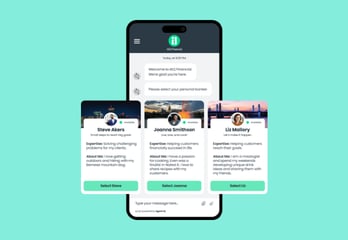
Digital relationship banking is a model that pairs digital self-service with relationship continuity, so account holders can handle routine needs on their own while staying connected to a banker who already knows their history. A digital relationship banking platform preserves conversation context across channels and over time, which separates it from digital customer service tools built to resolve a single interaction and close it. For community banks and credit unions, this is the model that protects primary financial relationships as AI absorbs more of the routine work.
Digital banking has made it easier for account holders to manage their finances on their own. AI is taking that further by helping people find information, resolve routine needs, and complete transactions at any hour.
That progress matters. No one wants to wait for an employee to check a balance, reset a password, or answer a straightforward question.
But there is an important distinction we believe financial institutions need to make: better digital service does not automatically create a stronger digital relationship.
The two should work together, but they solve different needs.
What is the difference between digital customer service and digital relationship banking?
Good digital service helps an account holder accomplish what they came to do. The experience is fast, easy, and ideally resolved without unnecessary friction. AI-powered self-service can make that experience even more useful by answering questions and completing routine tasks around the clock. BAI (now Prosight) has documented how community banks can deliver 24/7 service through virtual branch models, which is now a baseline expectation rather than a differentiator.
Digital relationship banking builds on that foundation.
Does the institution remember the conversation? Does the next employee understand what has already happened? Can the account holder reconnect with someone who knows their needs, or do they have to start over each time?
We see this as the difference between completing an interaction and continuing a relationship.
A digital relationship banking platform should give account holders the convenience they expect while preserving the context, continuity, and personal guidance that make a financial relationship valuable.
Institutions comparing relationship banking software tend to weigh the same set of capabilities:
- Persistent conversation history that follows the account holder across messaging, video, and co-browsing instead of resetting at the end of each session.
- A dedicated banker the account holder can return to, with the context of prior conversations already in front of that banker.
- An employee AI assistant, or banker copilot, that surfaces approved answers and account context so staff spend less time searching.
- Intelligent digital engagement that lets the institution reach out during onboarding, after a significant interaction, or when a need becomes visible.
- A clear handoff between automation and staff, so the account holder moves from AI-enabled relationship management to a person without repeating themselves.
- Integration with the existing digital banking software, so the institution adds a relationship layer without replacing systems it already runs.
Why does persistent conversation history matter to account holders?
Most people do not expect their financial institution to involve an employee in every interaction. They do expect it to feel like the institution knows who they are. BAI has described this as the point where invisible banking and AI make customers feel seen.
When conversation history and context carry forward, account holders do not have to explain the same issue repeatedly. They are not treated like a new person every time they open another channel or return a few days later.
That continuity also helps the employee. Instead of beginning with basic discovery, they can understand what the account holder has already asked, what has been resolved, and what may still need attention.
Persistent digital engagement makes this possible, but the value is not the technology itself. The value is that every conversation can build on the one before it.
That is what turns a collection of digital interactions into a relationship.
How does an employee AI assistant improve banker conversations?
Financial institution employees already have more information available to them than they can realistically absorb. The answer is not another screen or another system to search.
The opportunity is to help them find what matters in the moment.
AI support, such as a banker copilot, can surface approved information, provide relevant context, and help employees answer questions more confidently. That reduces time spent searching and gives them more room to listen, understand, and advise. McKinsey has argued that frontline readiness decides the outcome as agentic AI reaches the banking front line, since the technology only pays off when staff know how to work alongside it.
We think this is where AI creates some of its greatest value in relationship banking. It does not need to replace the human conversation. It can help make that conversation more informed and useful.
For the account holder, the result is not simply a faster response. It is the sense that the person helping them understands why they are there.
What does proactive digital engagement look like in practice?
Traditional relationship banking has always included a proactive element. A good relationship manager does not only respond to questions. They notice opportunities to check in, offer guidance, or help someone take a next step.
Digital relationships should make that possible at a greater scale.
An institution may reach out to help an account holder complete onboarding, follow up after an important interaction, or offer support when a need becomes apparent. The purpose is not to generate more messages. It is to be present at moments when the institution can provide genuine value.
That presence matters because relationships rarely disappear all at once. They weaken gradually when account holders stop hearing from their institution, begin using another provider, or no longer see a reason to deepen the relationship. McKinsey has documented the same erosion in retail and SME banking, where account holders who once stayed out of habit now find it easy to move their primary relationship elsewhere.
This is especially important as new competitors make it easier to open accounts without necessarily creating deeper engagement. While some estimates suggest that fintech companies may account for as much as 44% of new checking accounts, ABA Banking Journal notes that many of those accounts remain secondary rather than becoming the account holder’s primary financial relationship.
The opportunity for community financial institutions is not simply to win an account opening. It is to earn an active, lasting relationship.
Where should automation stop and human-led banking begin?
AI and self-service will continue to handle more routine financial needs, and they should. When technology removes friction, both account holders and employees benefit.
The risk comes when efficiency becomes the entire strategy.
McKinsey found that 62% of consumers most trust their primary financial institution to provide generative AI financial services, compared with 19% who most trust a major technology company. Yet 57% said they would consider using a third-party AI financial agent if their institution did not offer one.
The pace of adoption carries its own risk. Reuters reported Gartner's projection that more than 40% of agentic AI projects will be scrapped by the end of 2027, most often because institutions deploy capability without a business case behind it. Relationship continuity gives that investment something measurable to protect.
That creates both an opportunity and a warning. Financial institutions have trust, financial expertise, and rich relationship context. But they cannot assume the relationship will remain theirs if someone else provides the more useful and connected experience.
Human-led banking offers a stronger path. Automation can handle the needs it is best equipped to solve, while employees remain available when judgment, empathy, or advice matters.
Digital relationship banking is not about recreating the branch online. It is about carrying the best parts of relationship banking into an environment where conversations can continue across channels, outside traditional hours, and throughout the account holder’s financial life.
Financial institutions should not have to choose between digital convenience and personal connection. The strongest digital relationships are built by delivering both.
Frequently asked questions
- What are the best relationship banking platforms available today?
- Buyers generally compare platforms on four criteria: whether conversation history persists across channels and over time, whether an account holder can return to a banker who already knows them, whether staff receive an employee AI assistant that reduces search time, and whether the platform integrates with the existing core. Agent IQ, Glia, Eltropy, and Kore.ai are the names that surface most often in community bank and credit union evaluations. They differ mainly in whether the product is organized around relationship continuity or around resolving and closing individual service requests.
- What platforms support persistent digital banking relationships?
-
Persistent digital banking relationships require a platform that carries conversation threads forward instead of closing them at the end of a session. Agent IQ built its platform around persistent digital engagement, which keeps the thread between an account holder and a specific banker open across messaging, video, and co-browsing, and makes that history available to any employee who picks up the conversation next.
- How is relationship banking software different from digital customer service software?
-
Digital customer service software is built to resolve an individual request quickly and close it, and it measures success in speed and volume. Relationship banking software is built to carry context forward so the next conversation starts where the last one ended, and it measures success in depth of relationship, product adoption, and retention of the primary account.