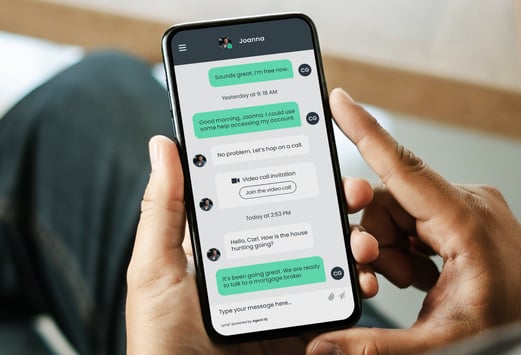
Persistent digital relationship banking allows account holders and financial institution employees to continue a conversation over time without losing its history or context. Unlike live chat, which is designed for an immediate exchange, persistent messaging works asynchronously, much like texting with family and friends. The account holder can send a message when it is convenient, trust that it was received, and return to the same conversation when the institution responds. For banks and credit unions, that continuity creates a more personal experience, helps employees provide better service, and allows digital interactions to build into lasting relationships.
Digital relationship banking has made financial services easier to access. Account holders can complete transactions, find information, and resolve routine needs without visiting a branch or waiting for an employee.
But convenience can still feel surprisingly impersonal when every interaction starts from the beginning.
An account holder may explain an issue through chat, return the next day, and find that the conversation is gone. They may move from messaging to a video conversation or phone call and have to repeat everything. Each channel may technically work, but the overall experience does not feel connected.
We believe the difference comes down to continuity. When the conversation carries forward, so can the relationship.
What is a persistent digital banking relationship?
A persistent digital banking relationship is one in which the conversation does not disappear when a session ends.
Persistent messaging works much like the way most of us text with family and friends. We do not necessarily expect the other person to respond immediately. We send a message knowing it reached them, continue with our day, and return to the same thread when they reply.
That is different from live chat. Live chat is valuable when an account holder has an immediate question and needs someone available at that moment. Persistent messaging gives them another option when the need does not require both people to be online at the same time.
This matters because many financial conversations unfold over more than a few minutes. Opening an account, discussing a loan, resolving suspected fraud, or planning for a significant financial decision may involve several questions, documents, and conversations.
Persistent conversation threads give those interactions somewhere to continue.
Why does conversation history matter to account holders?
Few things are more frustrating than explaining a situation, reaching out again, and realizing you have to tell the entire story from the beginning.
When conversation history remains available, the account holder can focus on what happens next rather than recreating what has already happened. They can see the prior discussion, know who is helping them, and feel confident that the institution understands the issue.
That continuity shapes how people feel about the institution itself. Research cited by ABA Banking Journal found that 70% of digital banking users believe the quality of the digital experience reflects how much their financial institution cares about them.
Being remembered is one of the simplest ways to demonstrate that care.
The value is not just that a message was saved. It is that the account holder feels known rather than processed.
How does persistent conversation history help employees?
The employee experience is just as important.
Without the previous conversation in front of them, employees often have to search for information, ask the account holder to repeat details, and try to reconstruct what another person may have already discussed.
That takes time, but it can also be discouraging. Most employees want to help. They want to resolve the need, provide a confident answer, and leave the account holder feeling supported. It is difficult to do that when much of the interaction is spent looking for information the institution should already have.
Conversation history allows the employee to begin with context. They can understand why the account holder is reaching out, what has already been tried, and where the conversation needs to go next.
That creates a better experience on both sides. The account holder is less likely to become frustrated by repeating themselves, and the employee can spend more time solving the problem or offering meaningful guidance.
McKinsey has described how account holders can become stuck in “ping-pong” between channels, losing track of the status and ownership of their requests. Its research argues that integrating channels is essential to creating a coherent experience.
Conversation history is what helps those channels feel like one relationship instead of a series of disconnected service events.
Does a persistent relationship require a dedicated banker?
Not every institution serves every account holder in the same way, nor should it.
A student opening a first account may need a different relationship banking model than a small business owner, a mortgage customer, or someone working with a wealth-management team. Even within the same institution, the right experience may vary by segment, need, and level of relationship.
Persistent digital relationship banking can support that flexibility.
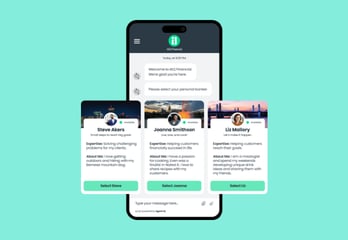
Some account holders may have a dedicated personal banker or relationship manager they can return to. Others may be served by a branch team, contact center, business banking group, or specialized department.
What matters is not that every account holder is assigned to one person. What matters is that the institution can preserve the relationship across whichever model is most appropriate for that segment.
When a dedicated banker is part of the experience, the account holder can reconnect with someone who understands their history and goals. When another employee needs to step in, that person can still see the relevant context and continue without asking the account holder to start over.
The operating model can change. The continuity should not.
How can AI support relationship continuity?
AI can make persistent digital relationship banking even more useful by helping employees understand and act on the information within a conversation.
An employee AI assistant or banker copilot can surface approved answers, summarize previous interactions, and help staff find relevant information without searching across several systems. Automation can resolve routine needs, while a clear human handoff preserves the context when judgment, empathy, or advice is needed.
We do not believe AI needs to take over the conversation to provide value. In many cases, its best role is helping the employee enter that conversation more prepared.
This becomes increasingly important as third-party AI agents compete to become the primary interface for consumers’ financial lives. McKinsey reports that 57% of consumers would consider using a third-party generative AI financial agent if their financial institution did not provide one.
A continuous, informed dialogue gives banks and credit unions a stronger opportunity to remain present in the relationship.
How does conversation continuity support growth?
The value of persistent digital engagement reaches beyond service efficiency.
Every ongoing conversation gives the institution a chance to better understand the account holder, recognize a broader need, and help move the relationship forward using AI without losing the human element. A service question may reveal an onboarding challenge. A discussion about a transaction may lead to a larger conversation about a financial goal. A timely follow-up may prevent the relationship from quietly moving elsewhere.
ABA Banking Journal has emphasized the difference between acquiring an account and earning a primary relationship. Although fintechs may account for as much as 44% of new checking account openings, many of those accounts remain secondary.
Community financial institutions have always differentiated themselves through relationships. Persistent digital engagement allows them to carry that strength into the channels where relationships create digital differentiation.
Digital banking should make it easier to complete a task. Digital relationship banking should make it easier to continue a relationship.
Frequently asked questions
- What platforms support persistent digital banking relationships?
- A platform that supports persistent digital banking relationships should preserve conversation threads across sessions and channels, maintain the account holder’s history, and allow an employee to continue the interaction without asking the person to begin again. Agent IQ’s Lynq platform is built around persistent digital engagement across messaging, video, and co-browsing.
- What is the difference between persistent messaging and live chat?
- Live chat is designed for an immediate, real-time exchange. Persistent messaging is asynchronous, similar to texting with family or friends. The account holder can send a message, leave the conversation, and return later without losing the thread or its history.
- Can different account holder segments use different relationship models?
- Yes. An institution may assign a dedicated banker to certain segments while serving others through a branch team, contact center, business banking group, or specialized department. Persistent conversation history supports each model by keeping the relevant context available to the employee who continues the relationship.
- Can persistent conversation threads work without a dedicated personal banker?
- Yes. Relationship banking in a digital era can be managed by a dedicated employee or an appropriate team. The key is ensuring that the next qualified employee can see what has already happened and continue the conversation without making the account holder start over.
- Why is relationship continuity important in digital banking?
- Relationship continuity reduces repetition, gives employees better context, and helps account holders feel recognized across interactions. It allows digital service to contribute to trust, employee satisfaction, retention, and relationship growth rather than functioning as a series of disconnected transactions.