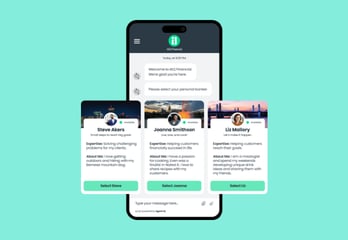
Digital relationship management helps community banks and credit unions carry their strongest advantage, personal relationships, into digital channels. Unlike transactional digital service, which is typically designed to resolve an immediate request as quickly as possible, digital relationship management preserves context, conversation history, and human connection over time. It combines self-service, persistent messaging, proactive outreach, flexible routing, and human support so account holders get the convenience they expect without becoming anonymous to the institution serving them.
Think about the best experience someone can have in a branch.
The employee does not begin every conversation from scratch. They may recognize the person. They understand why they are there. They know when a simple answer is enough and when it is time to bring in a lender, business banking specialist, wealth advisor, or someone else who can help.
Most financial institutions would never intentionally design a branch where every visitor had to introduce themselves again each time they walked through the door.
Yet that is still how a lot of digital service works.
What is the difference between digital service and digital relationship management?
Traditional digital service is built primarily around the transaction or request.
An account holder has a question. They enter a live chat, call a contact center, or submit a request. The institution resolves the issue, the interaction ends, and both sides move on.
There is nothing wrong with that model. In fact, it works extremely well for many needs.
If someone needs a routing number, wants to understand a transaction, or needs help resetting a password, the goal should be to resolve that need quickly and easily. AI self-service can make that experience even faster.
But resolving a service interaction and building a relationship are not the same thing.
Digital relationship management asks a different set of questions.
Does the institution remember what happened after the interaction ends?
Can the account holder return to the same conversation tomorrow?
Can the employee see what has already been discussed?
Can the institution recognize a broader need and follow up?
Can the account holder reach the right person when the conversation becomes more important?
We believe that is the difference between digital service and digital relationship banking.
One helps complete the interaction. The other helps the relationship continue.
|
|
Traditional digital service |
Digital relationship management |
|
Primary goal |
Resolve an individual request |
Build an ongoing relationship |
|
Conversation history |
Ends when the session ends |
Persists across interactions |
|
Employee context |
Starts from scratch each time |
Sees what has already been discussed |
|
Who responds |
The next available agent |
An assigned banker, team, or specialist based on the relationship model |
|
Timing |
Both people present at the same moment |
Asynchronous, similar to texting |
|
Outreach |
Reactive, begins when the account holder asks |
Proactive, employees can initiate relevant conversations |
|
Common measures |
Handle time, ticket volume, deflection rate |
Adoption, engagement, relationship depth, growth |
Why does digital relationship management matter for community financial institutions?
Community banks and credit unions already have something many larger competitors spend enormous amounts of money trying to create: trust.
People often choose a community financial institution because they want more than a place to complete transactions. They want people who understand their needs, know their community, and are available when a financial decision becomes more complicated.
The challenge is that those relationships increasingly have to exist outside the branch.
We think that is exactly the opportunity.
Technology does not have to make a community financial institution behave more like a megabank. Used well, it gives the institution more opportunities to deliver the personal experience that already makes it different.
And account holders are connecting that digital experience directly to how they feel about their institution. Seventy percent of digital banking consumers say the quality of their provider's digital experience reflects how much the institution truly cares about them.
The digital experience is no longer separate from the relationship.
It is part of the relationship.
Should every account holder have the same relationship model?
No, and we think this is an important distinction.
A student opening a first checking account probably does not need the same engagement model as a business owner managing cash flow. A wealth client may expect direct access to a specific relationship manager. A retail account holder may simply want convenient service from a knowledgeable team and easy access to a specialist when needed.
The right model can vary by institution, segment, and need.
For example:
- Students and younger account holders may prioritize digital access, fast answers, financial education, and guidance as new needs emerge
- Retail account holders may benefit from a service team that remembers previous conversations and can connect them with specialists when necessary
- Small business owners may value persistent access to a relationship manager or team that understands their business and can bring in treasury, lending, or other expertise
- Wealth clients may expect a named advisor, higher-touch communication, and more proactive outreach
- More complex relationships may require a broader team rather than a single point of contact
The important part is not whether every person has a dedicated banker.
It is whether the institution can design the relationship model that makes sense for that person and preserve the context as the relationship develops.
Good relationship technology should support the institution's operating model rather than forcing the institution to change its model to fit the software.
What should digital relationship management actually include?
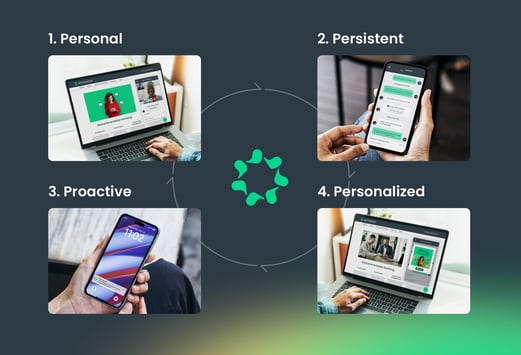
We tend to think about strong relationship banking through four ideas: personal, persistent, proactive, and personalized.
Personal
People should be able to reach a knowledgeable employee when human guidance matters.
Sometimes that is a dedicated relationship manager. Sometimes it is a team. Sometimes it is a specialist brought into the conversation because the need has changed.
The technology should make that connection easier, not put another barrier in front of it.
Persistent
Relationships do not happen in isolated sessions.
If someone sends a message today and returns tomorrow, the conversation should still be there. If another qualified employee needs to step in, the relevant context should be available.
Persistent messaging works much like texting the people in our own lives. We do not assume the other person will answer instantly, but we trust that the message arrived and that the conversation will still be there when they respond.
That is very different from a live chat session designed around both people being present at the same moment.
Proactive
Strong relationships are not purely reactive.
A great employee might check in after an account opening, follow up after a complicated service issue, reach out to a business account holder about something relevant, or offer guidance when a new need becomes visible.
Digital relationship management should make that type of thoughtful outreach possible at greater scale.
The goal is not more notifications.
It is more useful moments.
Personalized
Different account holders need different experiences.
Personalization is not simply inserting a first name into a message. It is deciding who should serve the relationship, what type of support is appropriate, what information is relevant, and how the institution should engage based on that account holder's needs.
This is one reason integrated digital and human engagement can have such a meaningful impact. McKinsey reports that financial institutions experimenting with more integrated channel models have seen outcomes including doubled digital sales, three times greater cross-sell, and a 40% increase in customer activity.
The point is not simply to add more channels.
It is to make those channels work together around the person using them.
Where does AI fit into digital relationship management?
AI should make the relationship easier to manage, not make the institution harder to reach.
There are routine questions account holders should be able to resolve immediately without waiting for an employee. There are also repetitive tasks employees should not have to spend their day doing manually.
AI can help with both.
It can provide self-service for straightforward needs, help employees access trusted information, summarize relevant context, and support a smoother transition when a human needs to become involved.
But the relationship still matters.
That becomes even more important as third-party AI begins playing a greater role in people's financial lives. McKinsey found that 62% of surveyed consumers most trust their primary financial institution to provide generative AI financial services, while 57% would consider using a third-party financial AI agent if their institution did not offer one.
That is an interesting tension.
Financial institutions have a meaningful advantage in trust. But they cannot assume that trust automatically guarantees the digital relationship.
The opportunity is to use AI to make the institution more responsive, informed, and useful while preserving an easy path to a person when the conversation calls for one.
What should financial institutions look for in relationship technology?
The best community financial institution relationship technology should fit the way the institution already wants to serve its account holders.
We would look for seven things:
- Persistent conversation history so context continues across interactions instead of disappearing after a session
- Flexible relationship models that can connect an account holder with a specific employee, team, specialist, or shared service group
- Multiple digital ways to engage, including persistent messaging, live chat, video, co-browsing, voice, and other appropriate channels
- Proactive outreach so employees can initiate useful conversations instead of always waiting for account holders to ask for help
- AI self-service with human handoff so routine needs can be resolved quickly without creating a dead end when the situation becomes more complex
- Integration with existing digital banking technology so the institution can strengthen the relationship experience without replacing the systems account holders already use
- Measurement beyond service volume so leadership can understand adoption, relationship depth, engagement, employee efficiency, and growth
Lynq® by Agent IQ was designed around this type of flexible relationship model, with persistent messaging, conversation history, intelligent routing, video, co-browsing, proactive outreach, and support for assigned, pooled, or hybrid service models.
The technology matters.
But the better question is always what kind of relationship the technology allows the institution to create.
How can digital relationship management contribute to growth?
This is where the conversation moves beyond customer service.
Every interaction contains information.
An account holder may ask a service question that reveals they are preparing to buy a home. A business owner may mention a cash flow problem that creates an opportunity for guidance. A new account holder may complete account opening but never activate the services that would make the institution their primary financial relationship.
Those moments already happen.
The difference is whether the institution can recognize them and act on them.
Digital relationship management creates continuity around those conversations. Employees have more context. Outreach can become more relevant. Different teams can collaborate around the same account holder instead of operating in separate channels.
And account holders do not have to rediscover the institution every time they need something.
As AI begins playing a larger role in financial decision-making, McKinsey argues that institutions seeking to protect the primary financial relationship will need to create a continuous, proactive financial dialogue rather than simply waiting for individual service or sales events.
We think community banks and credit unions are particularly well positioned for that future.
They do not need technology to manufacture a relationship advantage.
They already have one.
The opportunity is to make sure that relationship remains just as visible, useful, and personal when the account holder is holding a phone instead of walking through the front door.
Frequently Asked Questions
- What is digital relationship management in banking?
- Digital relationship management is an approach that preserves account holder context and relationship continuity across digital interactions. Unlike transactional digital service, which primarily focuses on resolving an immediate request, digital relationship management combines self-service, persistent messaging, proactive engagement, flexible employee routing, and human support so interactions can build into an ongoing relationship.
- How is digital relationship management different from a contact center or live chat?
- Contact centers and live chat are typically optimized to resolve a service need efficiently. Digital relationship management extends beyond that interaction by preserving conversation history, maintaining context over time, connecting account holders with the appropriate people, and enabling the institution to engage proactively after an individual service request has ended.
- Which AI vendor is best for community banks and credit unions?
-
There is no single best AI vendor for every financial institution. The right choice depends on the institution's goals, operating model, and risk requirements. An institution focused on relationship growth should evaluate whether a vendor supports persistent conversation history, human handoff, proactive engagement, flexible routing, trusted AI, integration with existing digital banking systems, and measurable relationship outcomes.
- Which AI platforms improve account holder engagement?
-
Financial institutions should look for AI platforms that improve convenience without removing the personal service that differentiates relationship-focused institutions. Useful capabilities include AI self-service, persistent messaging, employee assistance, proactive outreach, conversation history, video, co-browsing, and routing that can adapt to different account holder segments.
- Is digital relationship management the same as CRM?
- No. CRM systems primarily organize information about account holder relationships. Digital relationship management focuses on how those relationships are experienced across conversations and channels. The two can complement each other, but they solve different problems.
- Does digital relationship management require a dedicated personal banker?
-
No. A dedicated banker or relationship manager is one possible model. An institution can also use teams, branches, contact centers, business banking groups, wealth teams, or specialists. The important capability is preserving context and connecting the account holder with the right person based on the institution's relationship strategy.