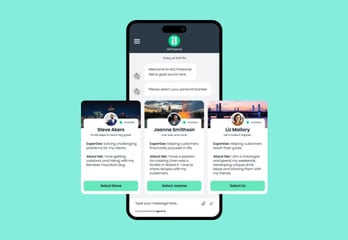
Community banks and credit unions can use artificial intelligence (AI) to reduce customer churn by identifying early signs of disengagement, automating proactive outreach, resolving service issues and connecting account holders with employees before relationships weaken. AI-powered customer engagement platforms can help financial institutions recognize behavioral signals, initiate personalized conversations and uncover opportunities to strengthen existing relationships.Because the best retention strategy is not saving someone at the moment they decide to leave.
It is giving them more reasons to stay along the way.
What does churn look like before an account holder leaves?
Consider someone who opens a new checking account.
They download the app, make an initial deposit, and perhaps ask how to set up direct deposit. Then nothing. Their paycheck stays at another institution, and the new account never becomes part of their everyday financial life.
Technically, that person has not churned.
But the relationship never really took hold either.
That is why retention cannot only be measured when an account closes or deposits leave. There are signals much earlier that an institution may be losing the opportunity to become more valuable.
The question is whether anyone notices them.
How can AI create more opportunities to strengthen a relationship?
AI can help surface moments that might otherwise get missed.
An onboarding step was never completed. Someone has asked the same service question several times. A certificate is nearing maturity. An application was abandoned. A previous conversation ended with something that still needs a follow-up.
None of those automatically means someone is leaving.
But each might be a reason to start a conversation.
And that conversation can uncover much more than the original issue.
Someone asking about moving money may mention they are buying a house. A small business owner calling about a transaction may reveal that they are adding employees. An account holder asking about a CD maturity may also be thinking about retirement.
Those are retention opportunities, but they are also relationship-growth opportunities.
The more useful conversations an institution creates, the more it can understand what an account holder actually needs and offer relevant advice, services, or expertise.
What does retention-focused outreach look like?
Go back to that new checking account.
Instead of waiting for the account to become dormant or adding the person to another generic email campaign, the institution could reach out:
Need a hand moving your direct deposit? We can help you get it set up.
That is a very different interaction from sending another product offer.
And if the account holder responds that they have not moved their paycheck because they are unsure how to organize accounts between two institutions, now there is a conversation to have.
With Lynq, financial institutions can initiate timely outreach through push notifications, then continue the interaction through authenticated, persistent messaging.
The first message may begin as a retention touchpoint. What comes out of the conversation could be education, advice, another service need, or an opportunity to deepen the relationship.
That is the bigger value.
Where should AI stop and an employee step in?
AI can handle routine questions, surface relevant knowledge, and help employees understand what has already happened.
But there are moments when what someone really needs is a conversation.
Deloitte's 2025 banking research found that 74% of surveyed customers preferred a human representative over a chatbot even for routine banking questions.
That does not mean AI has a smaller role. It means AI and people need to work together.
An AI assistant might answer the initial question immediately. But if that question turns into a discussion about buying a home, starting a business, managing debt, or planning for retirement, an employee may be in a much better position to help.
The handoff should feel like a continuation, not a restart.
Why does this matter even more as AI changes financial relationships?
Financial institutions have an advantage that is easy to overlook: people already trust them with their financial lives.
McKinsey found in 2026 that 62% of surveyed consumers most trusted their primary bank to offer generative AI financial services, compared with 19% who chose a major technology company.
But that position is not guaranteed.
McKinsey also describes a future in which third-party AI agents could increasingly sit between consumers and their banks, helping people choose products and make financial decisions without ever visiting the bank's digital experience.
That makes the relationship itself increasingly valuable.
The institution that knows the account holder, stays engaged, and continues to provide useful advice has a much better reason to remain part of the next financial decision.
How should financial institutions measure the impact?
Do not stop at chatbot containment or the number of outbound messages sent.
Look at what happens to the relationship:
- Activation. Are new account holders actually beginning to use the relationship?
- Service recovery. Are issues being resolved before they become reasons to leave?
- Meaningful conversations. Is outreach creating useful interaction, not simply more messages?
- Relationship growth. Are conversations uncovering additional needs, products, advice, or services that genuinely help?
- Retention. Are active relationships, deposits, and engagement holding up over time?
Retention and growth do not have to be separate strategies.
Often, they start with the same thing: a better conversation.
The goal is not simply to keep an account from closing. It is to create enough value that when the next financial need comes up, the account holder thinks of your institution first.
Frequently asked questions
- How can banks reduce customer churn using AI?
- AI can help financial institutions recognize disengagement signals, resolve routine needs, and create timely opportunities for employees to engage before a relationship weakens.
- Can AI help banks grow relationships as well as retain them?
- Yes. Useful conversations can reveal additional financial needs and give employees opportunities to provide relevant advice, services, or products that deepen the relationship.
- Can AI predict when an account holder will leave?
- AI can identify patterns that may indicate disengagement, but those signals are not certainty. They are most valuable when they help an institution decide where a thoughtful conversation may be useful.
- What should banks measure beyond retention?
- Look at activation, meaningful engagement, service resolution, relationship growth, retained deposits, and whether account holders are increasingly bringing more of their financial needs to the institution.