AI for community banks does not need to start with a sweeping transformation plan. In fact, it probably shouldn’t.
The best place to start is usually much simpler: find a real problem, give AI access to the right information, put clear guardrails around what it can do, and make sure a person can step in when needed.
That is what responsible AI implementation looks like in practice. Not slowing innovation down, but making sure the technology earns the trust required to do more.
Where should a community bank start with AI?
Start with something people are already struggling with.
Maybe an employee has to search three different systems to find the latest account-opening requirement. Maybe an account holder cannot get a straight answer about a wire transfer without calling the bank. Maybe your contact center answers the same questions dozens of times a day.
Those are good AI use cases because the problem is easy to understand and the outcome is easy to see.
An employee AI assistant can surface an approved policy and show employees where the answer came from. AI-powered self-service can handle a routine question immediately, then connect the account holder with an employee when the conversation becomes more complicated.
That approach also lines up with where the industry is going. The American Bankers Association's 2026 research found banks prioritizing lower-risk AI applications that support human judgment rather than rushing toward fully autonomous decision-making.
You do not have to automate everything to make AI valuable.
Solve one frustrating problem well first.
What does responsible AI actually require?
An AI policy is important. But a document sitting on the intranet does not govern much by itself.
Bank Director's 2026 Technology Survey found that 88% of surveyed bank executives and directors said their institution had already drafted an acceptable-use policy for AI.
The more interesting question is what happens after that.
Before putting an AI application into employees' or account holders' hands, get clear on four things:
- What information can it use? Someone should own the policies, procedures, rates, and product information AI relies on
- Who should have access? Sensitive information should follow the same role-based controls you expect elsewhere in the institution
- What is AI allowed to do? Answering a question is very different from moving money, changing an account, or making a financial decision
- What happens when AI does not know? There needs to be a safe way to say, “I don't have an approved answer,” escalate, and bring a person into the conversation
Good governance is not about wrapping AI in so much process that nobody wants to use it.
It is about knowing where the boundaries are.
How do you keep AI from confidently giving the wrong answer?
This may be the most practical question of all.
Imagine an account holder asking about a certificate renewal and getting an answer based on last year's terms. The answer can be beautifully written, immediate, and completely wrong.
Speed does not make that a good experience.
The safer approach is to ground AI in information the financial institution has approved and keeps current. When possible, employees should also be able to see the source behind the answer.
That is a major difference between asking a general-purpose chatbot a banking question and using AI built around an institution's own knowledge.
The goal is not to make AI sound confident.
The goal is to make the answer trustworthy.
And when there is no reliable answer, AI should know when to stop.
Where should the human fit into the experience?
A lot of AI conversations become unnecessarily binary: AI or humans.
In banking, the better answer is usually both.
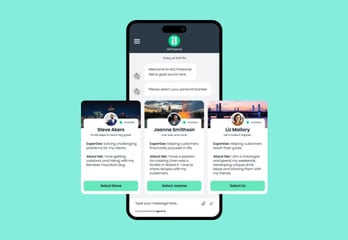
AI might answer someone's question about direct deposit in seconds. But that conversation could turn into something much more meaningful. Maybe the account holder is changing jobs. Maybe they are starting a business. Maybe they are trying to reorganize their finances.
Now there is an opportunity for a real conversation.
Depending on the institution and customer segment, that might mean an assigned relationship manager, a contact center employee, a branch team, or a specialist.
What matters is that the account holder does not suddenly feel like they have been dropped into a different experience and need to start over.
AI should make the human conversation better, not get in its way.
What changes when AI starts taking action?
This is where the stakes increase.
Generative AI might retrieve an answer, summarize a conversation, or draft a response.
Agentic AI can actually take steps across systems and complete work.
That requires a different level of control.
The more an AI system can do, the more important authorization, monitoring, auditability, and human oversight become.
NIST's AI Risk Management Framework organizes responsible AI around four activities: govern, map, measure, and manage.
For a community financial institution, the takeaway can be much simpler:
Know what the AI can do. Know what could go wrong. Know when a human needs to approve the next step.
How do you know if your AI rollout is working?
Do not measure success simply by saying, “We launched AI.”
Pick a workflow and test it with real people and real-world situations.
Give it the easy questions, but also give it the messy ones. Conflicting policies. Incomplete requests. Sensitive information. Questions the system should not answer.
Then look at what actually changed.
Are employees finding answers faster? Are account holders getting better service? Are escalations happening when they should? Do employees trust the information enough to use it?
And keep the technical lift in perspective. Bank Director found that 69% of respondents cited integrating new technology with existing systems as a top concern.
An AI project should not have to become a core replacement project before it provides value.
Start somewhere useful. Prove it works. Learn from it. Then expand.
Responsible AI is not one big decision.
It is a series of smart ones.
Frequently asked questions
- How can community banks implement AI responsibly?
- Start with a specific, lower-risk problem. Use institution-approved information, define access and AI permissions, keep people involved where judgment matters, and test outcomes before expanding.
- What is the best AI software for community banks?
-
Look beyond the demo. Strong banking AI should provide trusted answers, appropriate access controls, auditability, useful integrations, and a clear way to bring employees into the experience.
- Does responsible AI slow down innovation?
-
It should do the opposite. Clear guardrails make it easier to adopt AI confidently because teams understand what the technology can do, where it should stop, and how to expand it safely.
- Can credit unions use the same approach?
-
Yes. The principles are the same, but the workflows, terminology, service model, and employee handoffs should reflect how each credit union serves its members.