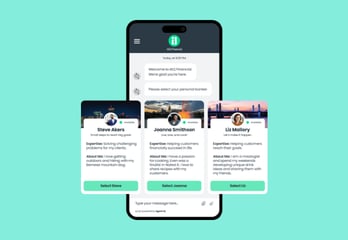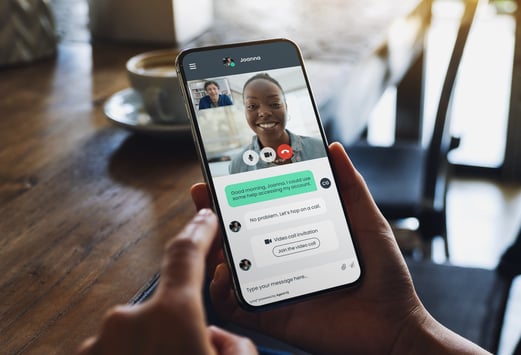
Human plus AI banking combines automation with human expertise so each can do what it does best. AI can handle repetitive work, surface information, and resolve straightforward needs quickly. Employees bring judgment, empathy, context, and guidance when the conversation becomes more complex or important.
We believe the goal is not to automate every interaction.
It is to use technology to make great human service easier to deliver and easier to scale.
Think about how we use technology in our own lives.
We are perfectly happy to let an app tell us when a package will arrive or automatically pay a utility bill. But when something goes wrong, the stakes change. Suddenly, we want a person who understands what happened and can help us figure out what to do next.
Financial services are no different.
Where should banking automation stop?
There are plenty of financial interactions where automation makes sense.
An account holder may want to know how to reset a password, find a routing number, check the status of a transaction, or understand how a feature works. Making someone wait for an employee to answer every routine question does not create a better relationship. It creates friction.
AI self-service can handle many of those predictable needs quickly, giving account holders the convenience they expect while freeing employees to focus on conversations where they can add more value.
The line starts to move when the question requires judgment, reassurance, an exception, or a deeper understanding of the account holder's situation.
A suspicious transaction is not simply a transaction question. A declined loan application may represent someone's plans for a home or business. A small business owner asking about cash flow may really need guidance on what comes next.
Those are the moments when AI with human handoff becomes more valuable than automation alone.
We do not read that as a rejection of AI. We see it as a reminder that speed is only one part of a good experience. Account holders also want confidence that someone can step in when the need becomes more important.
What is the role of people in AI-powered banking?
As AI gets better, we believe the human role becomes more valuable, not less.
Employees should spend less of their time searching for information, documenting routine work, preparing basic responses, or piecing together context from multiple systems.
They should have more time to listen, advise, solve problems, and build relationships.
That is where AI assistance for staff can have an immediate impact. An employee AI assistant can bring trusted institutional knowledge into the flow of work, helping staff find answers faster and respond with greater confidence.
The goal is not to turn every employee into an AI operator. It is to take some of the searching and repetitive work off their plate so they can spend more time helping people.
We are already seeing what that can look like at scale. Reuters reported that UBS's use of AI is allowing financial advisors to spend 70% of their time talking with clients rather than handling routine tasks.
That is a useful way to think about augmented intelligence banking.
The technology is not there simply to answer more questions without people. It is there to help employees enter conversations better prepared and with more time to focus on the work only a person can do well.
What should an AI to human handoff actually feel like?
A good escalation to an employee should not feel like starting over.
If an account holder has already explained the problem, answered questions, or provided information through an AI experience, that context should move with them when a person becomes involved.
The employee should already understand:
- Why the account holder reached out
- What information has been provided
- What the AI has already suggested or completed
- Why the conversation was escalated
- What needs to happen next
That sounds simple, but it is a meaningful difference.
A poorly designed handoff says, "Can you explain what's going on?"
A good handoff says, "I can see what's been happening. Let's figure this out."
We think the second experience is where technology starts to feel personal.
This kind of continuity is also central to digital relationship banking, where conversations, context, and human support carry forward instead of disappearing when one interaction ends.
How can community banks and credit unions implement AI responsibly?
Responsible AI does not require choosing between moving quickly and moving carefully.
It requires deciding where AI belongs.
A practical human-in-the-loop banking model can separate opportunities into three groups:
- Automate: Routine, predictable, and lower-risk interactions where speed and convenience matter most
- Assist: Employee work involving knowledge, summaries, preparation, recommended responses, and repetitive tasks while keeping the person in control
- Escalate: Conversations involving ambiguity, meaningful financial consequences, emotional situations, exceptions, or decisions where human judgment matters
This is close to how we think financial institutions can get the most value from AI without losing what makes their relationships valuable in the first place.
ABA research found that financial institutions are concentrating heavily on lower-risk AI applications that support human judgment while remaining cautious about more autonomous customer-facing decisions.
That feels like the right question to us.
Not simply, "Can AI do this?"
But, "Should AI do this on its own?"
Can human plus AI banking improve growth as well as efficiency?
This may be the most important part of the conversation.
It is easy to talk about AI in terms of efficiency. Fewer searches. Faster responses. Less repetitive work.
Those benefits matter.
But what happens with the time employees get back matters even more.
An employee with better information and fewer administrative distractions has more opportunity to understand an account holder's needs, recognize the next opportunity to help, and have a more valuable conversation.
McKinsey reports that financial institutions redesigning frontline work around agentic AI have seen 3% to 15% higher revenue per relationship manager and 20% to 40% lower cost to serve.
Those outcomes point to something bigger than automation.
When technology helps employees spend less time on transactional work, they can spend more time on trust, complex decisions, and long-term relationships.
That is where we believe the human plus AI banking model becomes especially powerful.
The best use of AI may not be removing the human from financial services.
It may be removing the things that get in the human's way.
Frequently asked questions
- What is human plus AI banking?
- Human plus AI banking is an operating model that combines automation and AI assistance with human judgment. AI handles appropriate routine work and helps employees access information, while people remain central to conversations that require advice, empathy, exceptions, or complex decision-making.
- What is human-in-the-loop banking?
- Human-in-the-loop banking keeps a person involved in AI-supported processes where oversight or judgment is needed. The employee may review an AI recommendation, approve an action, take over a conversation, or make the final decision.
- When should AI escalate to an employee?
- AI should generally escalate when an account holder's need becomes ambiguous, emotionally sensitive, high risk, financially significant, or outside the system's approved scope. A strong handoff should preserve the conversation history so the account holder does not have to repeat themselves.
- How can community banks and credit unions implement AI responsibly?
-
Start with clearly defined use cases where AI can reduce friction or help employees without creating unnecessary risk. Establish approved knowledge, governance, permissions, escalation rules, human oversight, and accountability before expanding into more autonomous AI workflows.
- What is the difference between automation and augmented intelligence in banking?
- Automation completes a task with limited human involvement. Augmented intelligence helps a person perform the task better. In financial services, that might mean an employee AI assistant finding the right policy, summarizing a conversation, preparing information, or recommending a response while the employee remains in control.