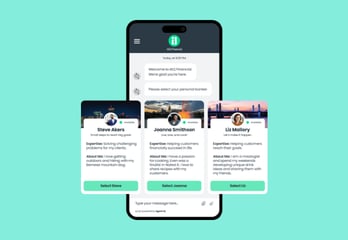
Customer conversation preparation AI can help financial institution employees walk into a conversation knowing more, searching less, and feeling better prepared to help. By summarizing recent interactions, surfacing relevant context, and making trusted institutional information easier to access, AI can take some of the work out of preparation. The employee still brings the judgment, empathy, and understanding of the person they are talking with.
Think about the few minutes before an important conversation.
You are trying to remember what was discussed last time. Maybe there are notes in one place, messages somewhere else, and a policy you need to double-check before you respond.
The account holder does not see any of that work.
They simply expect you to know who they are and pick up where the relationship left off.
That is where we think AI can be particularly useful.
How can AI help employees prepare for better conversations?
The best preparation is not necessarily more information. It is having the right information at the right moment.
AI can help pull together recent interactions, summarize what was discussed, surface outstanding needs, and make relevant institutional information easier to find.
That matters because employees already spend a surprising amount of time on everything surrounding the conversation.
McKinsey found that relationship managers at many commercial banks spend only 25% to 30% of their time in actual client dialogue.
We do not think the answer is simply asking employees to move faster.
The more interesting opportunity is using AI to remove some of the preparation and searching that gets in the way of the relationship.
What should employees know before a conversation?
Usually, it is not complicated.
What happened last time?
Is there something we promised to follow up on?
What does this person need right now?
Is there an institutional policy, product detail, or procedure I need to understand before I respond?
And is there someone else who should be part of this conversation?
That is what useful customer context looks like.
For digital interactions, this becomes particularly important because a conversation does not always happen in one sitting. Someone might start with a live interaction, come back through persistent messaging two days later, and eventually connect with a different employee.
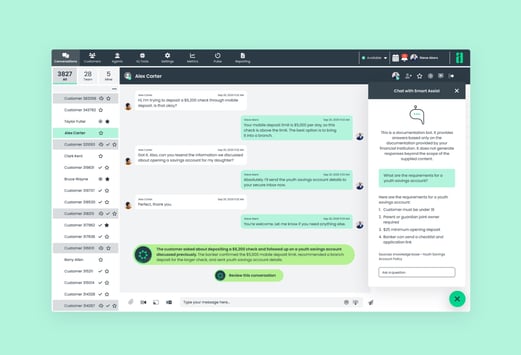
With Lynq® AI, conversation history and context can carry forward instead of disappearing when the interaction ends. AI-powered conversation summaries can also give an employee a quick way to understand what was discussed previously without rereading an entire thread.
That is a small thing technologically, but a very human thing experientially.
Nobody wants to start every conversation with, “Can you tell me what happened last time?”
Can AI suggest what an employee should do next?
It can help, but this is where we think the language matters.
Next-best-action banking should not mean turning the relationship over to an algorithm.
AI can surface relevant information, highlight an unfinished need, or suggest something the employee may want to consider. The employee still decides what makes sense.
That distinction becomes especially important in financial services.
A person may technically qualify for a product, but that does not automatically mean recommending it is the right next step. Context, judgment, timing, and trust still matter.
We believe AI works best when it makes a good employee better informed, not when it tries to make the relationship decision for them.
Does better preparation actually improve the conversation?
There are early signs that it does.
McKinsey reports that at some banks, AI-supported meeting preparation reduced preparation time by about 25% and freed roughly 10% more time for client interaction. Bankers also reported feeling better prepared and more confident.
That last part may be just as important as the time savings.
When an employee has the context in front of them, they can spend less time reconstructing the past and more time listening to what the account holder needs now.
That is a much better use of AI.
What makes AI preparation actually useful?
For us, a few things have to come together.
-
Context should be easy to absorb. Conversation history is valuable, but an employee should not have to read through pages of messages before responding. Summaries can quickly surface what was discussed, what remains unresolved, and where the relationship left off.
-
Institutional information should be trusted. If an employee needs to check a policy, procedure, or product detail, Smart Assist can provide an answer grounded in approved institutional knowledge, with citations back to the source.
-
The knowledge behind the AI needs governance. Smart Control helps institutions define how that knowledge is reviewed, approved, maintained, and made available based on roles and permissions.
Put those pieces together, and an employee can arrive at a conversation knowing both:
What happened with this account holder?
And:
What does our institution say about what they need?
That combination is where AI starts to feel less like another tool employees have to use and more like something that genuinely helps them do their job.
Because the goal is not to have AI carry the conversation.
It is to help a person walk into it better prepared.
Frequently Asked Questions
- How can AI help bankers prepare for meetings?
- AI can summarize previous interactions, surface relevant account holder context, identify outstanding needs, and make trusted institutional information easier to access before a conversation begins.
- What AI tools improve relationship manager productivity?
- Look for tools that reduce time spent searching and preparing, preserve conversation context, provide access to approved institutional knowledge, and fit naturally into the employee’s existing workflow.
- What is next-best-action AI in banking?
-
Next-best-action AI uses available context to surface a relevant next step or opportunity for an employee to consider. In a relationship-focused model, AI should support human judgment rather than make the decision independently.
- How can AI improve customer conversations in banking?
- AI can give employees faster access to previous conversation history, relevant customer context, outstanding needs and trusted institutional information. That allows employees to spend less time reconstructing what happened previously and more time listening and responding to what the account holder needs now.
- Can AI summarize previous customer interactions for bankers?
- Yes. AI-powered conversation summaries can help bankers quickly understand what was discussed previously, what remains unresolved and where the relationship left off without rereading an entire conversation history.
- How can banks and credit unions use AI without replacing human judgment?
- AI can surface relevant information, highlight unfinished needs and suggest possible next steps while leaving the final decision with the employee. Context, timing, judgment and trust remain important parts of the customer relationship.
- How can AI help bankers spend more time with customers?
- AI can reduce some of the time employees spend searching for information and preparing for conversations. By making relevant context and institutional knowledge easier to access, employees can devote more of their time to customer interaction.
- Why is trusted institutional knowledge important when using AI in banking?
- Bank employees need answers based on accurate, approved institutional information. AI grounded in governed institutional knowledge can help employees access relevant policies, procedures and product information while providing citations back to the source.