Picture a member visiting your website at 9:30 p.m. They want to know which documents they need to apply for an auto loan. Another member arrives the next morning with a more personal question: Which loan option makes the most sense for their situation?
Both members want help. Neither one is thinking about whether your credit union calls the experience AI chat, live chat, or something else. They simply want a useful answer and a clear next step.
That is why we think the more helpful question is not, “Which is better, an AI chatbot or live chat?” It is, “What kind of help does this member need right now?”
AI chat and live chat solve different problems. When they work together, they can give members quick access to information without taking away the personal guidance that makes a credit union relationship valuable.
What is the difference between an AI chatbot and live chat?
An AI chatbot provides automated assistance. It can answer common questions, guide members through defined processes, and help them find information without waiting for a member of staff.
Live chat connects a member with a person for a real-time conversation. Staff can understand context, ask follow-up questions, and provide guidance when a need is more complex, personal, or sensitive.
The difference is not simply technology versus people. It is the kind of help each experience is designed to provide.
AI chat is well suited for speed, availability, and repeatable service. Live chat is better suited for judgment, empathy, and relationship building. In many cases, a member will benefit from both during the same interaction.
When does AI chat work best?
AI chat works well when a member needs a clear answer or a straightforward next step. Think about the questions your staff answers repeatedly every day.
- What are your branch hours?
- What documents do I need to apply?
- How do I reset my password?
- Where can I find information about a product?
- How do I begin a routine service request?
A well-designed AI experience can answer these questions quickly, including outside normal business hours. It can also guide members through structured workflows and reduce the volume of routine requests reaching staff.
The information behind the experience matters. AI responses should be grounded in content the credit union has reviewed and approved. The institution should also be able to control which resources the AI can use.
Just as important, AI should recognize when self-service is no longer the right answer. A member should never feel trapped in an automated conversation when the situation calls for a person.
When does live chat work best?
Live chat becomes more valuable as the conversation becomes more personal.
- Comparing financial products
- Discussing a lending need
- Getting help with an unusual account situation
- Asking several connected questions
- Clarifying an answer that was not fully understood
- Receiving guidance during an application
- Discussing a sensitive or time-critical concern
These interactions are rarely resolved with one answer. Staff may need to ask questions, understand what the member is trying to accomplish, and adjust the conversation as new information emerges.
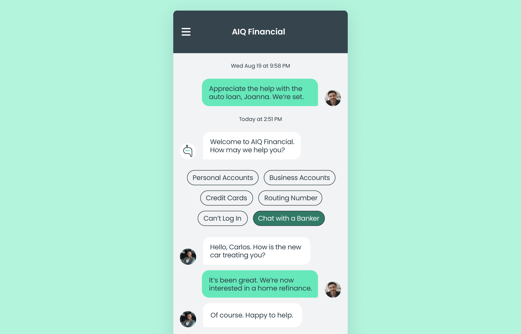
That is also where a service interaction can become a relationship opportunity. A member who begins with a question about an auto loan may also need help understanding payment options, eligibility, or the application process. A person can recognize that need and help the member move forward with confidence.
Do credit unions need both AI chat and live chat?
For many credit unions, the answer is yes.
AI chat and live chat are most useful when they are designed as connected parts of the member experience. AI can begin the conversation, answer routine questions, and guide a workflow. When the need becomes more complex, the conversation can move to a person.
The handoff is where the experience either feels connected or falls apart.
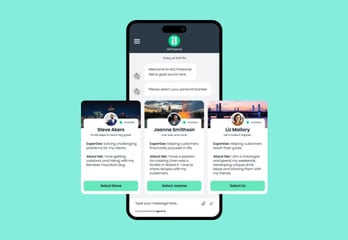
Members should not have to repeat the question, restart the process, or explain everything again. Staff should receive the relevant conversation context and continue from where the AI interaction ended.
A connected experience might look like this:
- A member asks a question on the credit union’s website
- AI provides an answer from approved institutional information
- The member asks for more help or reaches a defined handoff point
- The conversation moves to an available member of staff
- Staff receive the conversation context and continue helping the member
- When appropriate, the relationship continues through persistent messaging inside digital or mobile banking
This gives members the speed of self-service without removing access to a person.
AI chatbot or live chat: A practical way to think about fit
Legend: ✓ Strong fit ◐ Supporting fit ○ Limited fit
| Member need | AI chat | Live chat | Working together |
|---|---|---|---|
| Common informational question | ✓ | ◐ | ◐ |
| After-hours assistance | ✓ | ○ | ✓ |
| Structured service workflow | ✓ | ◐ | ✓ |
| Product comparison or financial guidance | ◐ | ✓ | ✓ |
| Complex or unusual account need | ○ | ✓ | ✓ |
| Sensitive conversation | ○ | ✓ | ✓ |
| High-volume routine requests | ✓ | ○ | ✓ |
| Relationship-building opportunity | ◐ | ✓ | ✓ |
This is not a rigid set of rules. The same conversation can move from one category to another as the member’s needs become clearer. The goal is to give each member the right kind of help at the right moment.
What should credit unions look for?
The technology matters, but the experience it creates matters more. We recommend looking beyond a feature checklist and asking how AI, staff, institutional knowledge, and existing digital channels will work together.
Answers grounded in approved information
AI should generate answers from content the credit union has reviewed and approved. The institution should be able to control the knowledge available to AI and maintain it as products, policies, and procedures change.
A clear path to a person
Human help should be part of the design, not an escape hatch hidden at the end. Members should be able to request assistance, and the credit union should be able to define when a conversation needs to move to staff.
A handoff that keeps the context
Staff should be able to see the conversation that occurred before the handoff. Preserving context reduces repetition and makes the next response more useful.
Routing that reflects how your credit union operates
Not every conversation belongs in the same queue. Routing can consider where the interaction began, the type of request, staff availability, capacity, expertise, team, and the member’s existing relationship.
Support for relationships that continue
Website chat is helpful for an immediate need, but financial conversations often extend beyond one session. Persistent messaging inside digital or mobile banking allows the member and credit union to continue the conversation over time.
Practical oversight and measurement
Credit unions should understand what members ask, how often AI provides a useful response, when members need more help, and where approved content needs to improve. Security, compliance, and risk teams should also be involved in evaluating how the experience will operate within the institution.
How Agent IQ brings AI and personal engagement together
We have built our approach around a simple belief: technology should strengthen human relationships, not replace them.
Lynq® AI combines the complete Lynq relationship-banking experience with AI-powered self-service. It supports structured intents, dialogs, and workflows, as well as generative answers grounded in institution-approved resources.
When a member needs personal help, the conversation can move from AI to a member of staff with context. Lynq also supports public website chat, persistent authenticated messaging, video, co-browsing, and other ways for members and staff to connect.
The result is not AI on one side and people on the other. It is a connected experience that uses each where it can provide the most value.
Give every member the right kind of help
Members do not think about service channels in isolation. They think about what they need and how easily they can get help.
Sometimes the right experience is an immediate answer. Sometimes it is a conversation with a person. Often, the interaction begins with one and develops into the other.
A thoughtful combination of AI chat and live chat can help credit unions improve access, use staff time more effectively, and preserve the personal relationships that set them apart.
Frequently asked questions
- What is the best AI chatbot for credit unions?
-
The best AI chatbot for a credit union is one that fits its service model and provides more than automated answers. It should use approved institutional information, support structured workflows, provide a clear path to staff, and preserve context during the handoff.
Credit unions should also consider how the technology connects with live chat, digital banking, routing, reporting, and their broader relationship strategy. - How can a credit union improve member service with AI?
-
A credit union can use AI to give members faster access to routine information, support them outside normal business hours, guide common workflows, and reduce repetitive requests handled by staff.
AI should complement the employee experience. The credit union should define when self-service is appropriate and when the member should be connected with a person. - What is the best live chat for credit unions?
- The best live chat experience is one that helps members reach the right person without unnecessary steps. Important considerations include routing, staff availability, conversation context, mobile accessibility, handoff from AI, and the ability to continue appropriate conversations through persistent messaging.
- Should a credit union use an AI chatbot, live chat, or both?
-
Many credit unions will benefit from using both. AI chat can handle immediate and routine needs, while live chat can support complex questions, personal guidance, and relationship-building opportunities.
The most important consideration is how the two experiences connect. Members should be able to move from self-service to a person without starting over.