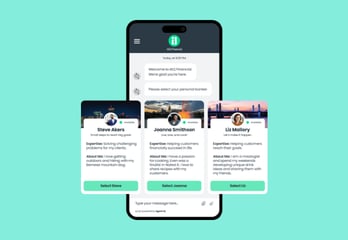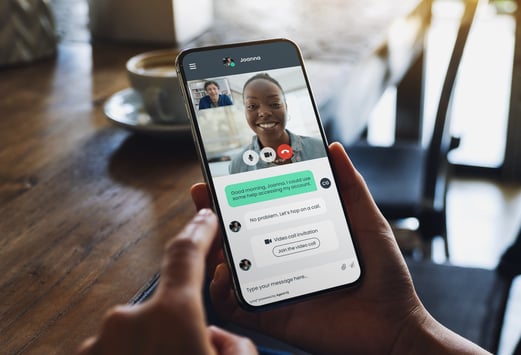
A video banking platform is most useful when video is not treated as a standalone feature. The stronger model lets an account holder move naturally between messaging, video, and co-browsing as the conversation changes, without losing context or having to start over. The point is not to add more channels. It is to make digital help feel easier and more human.
We have all had the opposite experience.
You start in chat. The issue gets complicated. Someone tells you to call another number or open a different app. Then you explain the whole thing again.
Technically, every channel worked.
The experience did not.
That is why we think the conversation about digital engagement should be less about how many channels a financial institution offers and more about how well those channels work together.
Why should a video banking platform combine messaging, video, and co-browsing?
Different moments call for different kinds of help.
A quick question about hours or a transaction may be perfect for chat or persistent messaging.
A conversation about a lending decision, business need, or something more personal may benefit from face-to-face video.
And sometimes the issue is much simpler: I am looking at the screen and cannot figure out what to do next.
That is where co-browsing can be far more useful than sending another set of instructions.
The important thing is giving the account holder a path from one type of interaction to another without creating friction along the way.
That matters even more as financial conversations increasingly start digitally. Forrester reported in April 2026 that 31% of consumers in the U.S., Canada, and the U.K. use conversational AI for at least some personal finance questions, and 24% of those consumers are turning to tools outside their financial institution’s ecosystem.
If the digital experience at the institution feels disconnected or difficult, it becomes easier for that relationship to move somewhere else.
When should financial institutions use messaging, video banking, and co-browsing?
This is where we would resist the temptation to make everything a video interaction.
Video is valuable precisely because it can be used when a conversation deserves it.
Video banking allows financial institution employees to provide face-to-face assistance through a digital banking experience, particularly when a conversation is complex, personal, or benefits from human guidance.
Persistent messaging works well when an account holder wants to ask a question, step away, and continue later. Live chat can help with needs that are immediate. Video adds a more personal connection when the situation becomes complex or important. Co-browsing can help an employee guide someone through a digital process while they are actually looking at it.
Deloitte’s 2025 banking research is a useful reminder that human help still matters. In its survey of 2,027 U.S. banking customers, 74% of respondents favored a human representative over a chatbot, even for routine interactions.
We do not read that as an argument against digital service or AI.
We read it as an argument for giving people an easy way to reach a person when that is what the moment calls for.
What does good co-browsing look like?
Co-browsing in banking allows a financial institution employee to visually guide an account holder through a digital experience in real time without requiring the account holder to leave the interaction.
Think about the difference between saying, “Go to the menu in the upper-right corner, click settings, then scroll down,” and simply showing someone where to go.
That is the value of co-browsing in banking.
It brings the clarity of sitting next to someone into a digital interaction.
With Lynq® co-browsing, the account holder remains in control of the session and can end it at any time. The employee can provide visual guidance without turning a straightforward digital task into a long explanation.
It can be a small difference in technology and a big difference in how supported someone feels.
Where should AI fit into the experience?
Ideally, AI handles what it can and makes the transition to a person easier when it cannot.
That distinction is important.
J.D. Power’s 2026 digital banking research found that virtual assistants perform well on simpler needs but satisfaction drops around more complex issues such as fraud, disputes, and problem resolution. The research specifically points to seamless escalation to human support as an area institutions need to improve. Read the J.D. Power research.
With Lynq AI, routine questions can be handled through guided or generative self-service, while conversation history and context can move with the account holder when an employee needs to step in.
The account holder should not have to choose between “AI experience” and “human experience.”
It should simply feel like one conversation.
What should financial institutions look for in a digital engagement platform?
We would focus less on the feature checklist and more on how the experience actually works:
- Can someone move easily between live chat, persistent messaging, video, and co-browsing?
- Does the conversation context carry forward?
- Can AI resolve routine needs and escalate appropriately when a person should step in?
- Can the institution route conversations based on its own service model, whether that means assigned employees, specialists, pooled teams, or a hybrid?
- Can employees quickly understand what has already happened before joining the interaction?
Those are the capabilities that turn separate digital tools into a better relationship experience.
With Lynq, financial institutions can move between live chat, persistent messaging, video banking, and co-browsing while preserving conversation history and context across interactions.
Because ultimately, the best video banking platform is not about getting more people onto video.
It is about giving every conversation the right level of human connection, exactly when it needs it.
Frequently asked questions
- Which banking platforms integrate video, messaging, and AI?
- Look for digital engagement platforms that combine persistent messaging, live chat, video banking, co-browsing, and AI-supported self-service while preserving context as an account holder moves between them.
- What is video banking?
- Video banking allows account holders to connect face-to-face with a financial institution employee through a digital channel. It can be especially useful for complex, personal, or high-value conversations where human guidance adds value.
- What should I look for in a video banking platform?
- Evaluate how easily account holders can enter and leave video, how video connects with messaging and co-browsing, whether employees retain conversation context, and whether the experience works inside the institution’s existing digital journey.
- Which AI engagement platforms include co-browsing?
- A number of banking engagement providers offer co-browsing. The more important question is whether co-browsing is integrated with messaging, video, AI escalation, routing, and conversation history so the account holder does not experience each capability as a separate channel.